Actors on strike in Hollywood: The billion-dollar industry on the brink of collapse
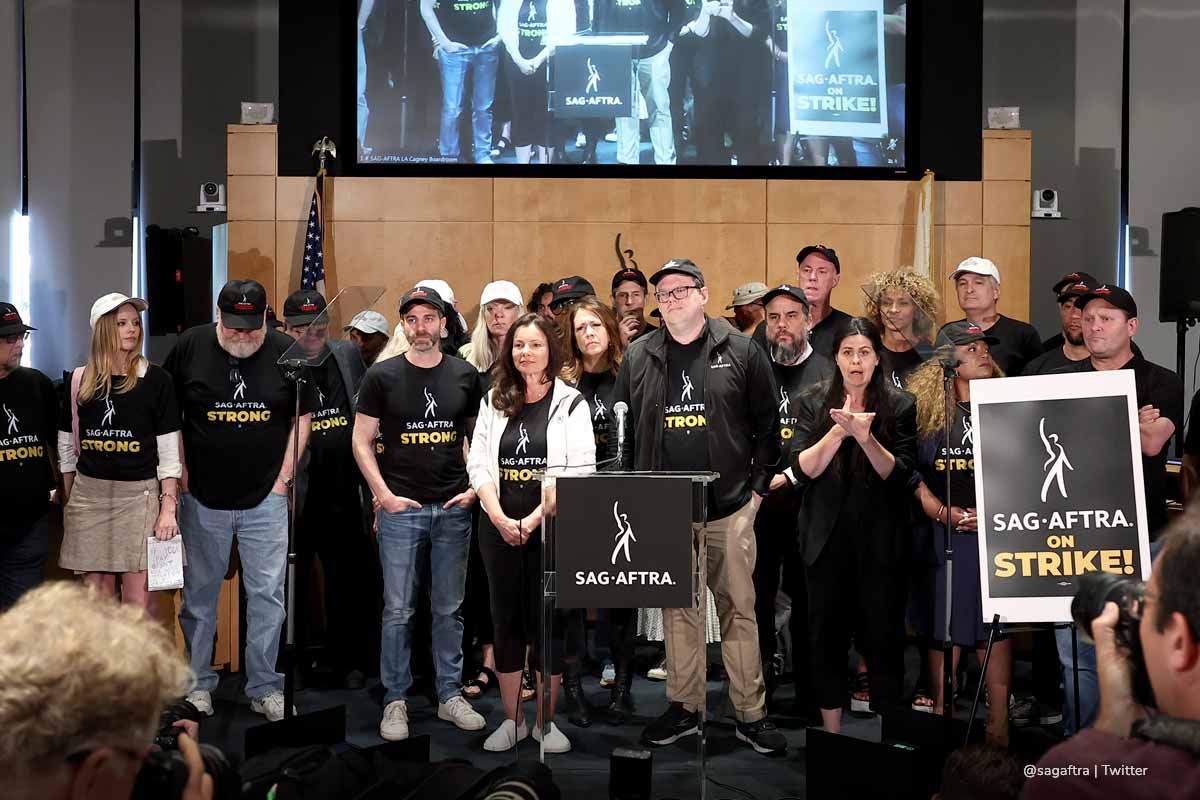
After attempts at negotiations failed on July 12, the actors on strike halted Hollywood productions. This has not been seen since 1980.
The president of the SAG-AFTRA union (Screen Actors Guild-American Federation of Television and Radio Artists), Fran Drescher, fondly remembered for her role in the 1990s series The Nanny, confirmed the start of the strike.
The SAG-AFTRA union, which brings together more than 160,000 actors, decided to take drastic measures in the face of what Fran Drescher herself calls “disrespect”, after seeking a consensus with the directives of the largest production studios in the union regarding working conditions in the face of the revolutionary streaming industry.
You may be interested in: Alarming! Traveling to Mexico has become a headache for Colombians
What do the actors on strike want?
On July 13, the actors’ strike in Hollywood began at a particularly tense time for the industry, as screenwriters have been on strike since May 2.
The value of the Hollywood film industry is estimated in billions of dollars, an amount that is at risk since screenwriters and actors have not been on strike since 1960, so this protest has put the filming of multiple productions on hold.
In his harrowing speech, Drescher stated that “the companies refused to make meaningful commitments on certain issues and on others they simply gave us vague answers. Until they demonstrate a sincere willingness to negotiate, we will not be able to reach an agreement”.
The actors on strike are demanding royalties in the case of reproduction and broadcast of productions with their participation. Some of these actors are Ben Affleck, Jennifer Lawrence, Pedro Pascal, Charlize Theron and Joaquin Phoenix.
For their part, the Alliance of Motion Picture and Television Producers (AMPTP), Netflix Inc representatives NFLX.O, Walt Disney Co DIS.N stated that, “instead of continuing to negotiate, SAG-AFTRA has set us on a course that will deepen financial hardship for thousands of people who depend on the industry for their livelihood”.
For now, the actors on strike have declared a cessation of film and series shoots, attendance at crowded events or premiere events, promotion of films or series, and recording of voice dubs.

The multi-billion dollar streaming business
There are more than 850 million households in the world subscribed to at least one streaming platform. This particular consumption, with unlimited access to series and movies on different platforms, skyrocketed in the Covid-19 pandemic. It is expected to raise more than $100 billion by 2025.
Today, streaming platforms monopolize 70% of the movement in the film industry.
The union’s actors state that they are concerned about the poorly regulated use of their image on platforms that make productions available to users on an unlimited basis, since the transmission of these productions does not represent any kind of income for the actors on stage.
Although this is the first time that the actors’ guild joins the screenwriters and writers’ guild, it is not the first time that the film industry faces demands for better working conditions, as film directors have also advanced negotiations on the matter.
You may also be interested in: Expovinos 2023: Latin America’s largest wine fair returns to Bogotá and Medellín
What is happening with cinema in Colombia?
The Colombian Actors Association (ACÁ) emerged in the renowned Fanny Mikey Theater on May 26, 2014. In its beginnings, ACÁ was formed with 699 actors and actresses, with the aim of promoting the welfare of the guild.
Faced with the movements of the actors on strike in Hollywood, the association has already expressed its support and solidarity with their colleagues.
A esta hora en todo el mundo los actores levantamos nuestra voz para decir, #YoEstoyConSAGAFTRA pic.twitter.com/NIP8isM7i1
— Asociación Colombiana de Actores (@actoresACA) July 13, 2023
According to the Ministry of Culture, a total of 214 films were released in the country in 2021. Of these more than 200 productions, only 14% were of Colombian origin, i.e. 31. The screening of these productions brought in $8.32 billion at the box office and around 809,525 spectators, in contrast to the 73.1 million spectators in 2019.
Of course, these figures should be understood as those of an industry affected by the pandemic that caused the closure of some independent movie theaters in the country. In addition, national film production has also had to face the challenges of consumption on streaming platforms.
Actor’s Law in Colombia
According to ACÁ, the Colombian Actors Association, the objective of the Actor’s Law is to “establish a set of measures for the promotion, encouragement and protection of the work of actors and actresses; dignify the exercise of acting; encourage professional training; guarantee the labor and cultural rights of actors and actresses in their performances”.
Law 1975 of 2019, promoted by ACÁ, was celebrated by actors and other Colombian artists, and comprises a series of measures that seek to promote the industry in Colombia.
Within the law, for example, priority is given to acting as a profession, as Performing Arts programs are recognized before the Ministry of Education as long as the educational entity complies with the standards established for recognition as an institution dedicated to professional training.
The Actor’s Law also stipulates that actors and actresses may work in productions as freelancers, under contract for the provision of services, as well as under fixed-term or indefinite-term contracts, i.e. as dependent workers.
In any case, the news of the actors on strike in the United States opens and promotes the discussion on the regulation of a changing multi-million dollar industry. The position of the striking actors has already affected the filming of Gladiator 2, Euphoria T3, Deadpool 3, among other Hollywood productions.
Keep reading: Everything about the tax filing deadline 2023