Is it better to take out a loan now or wait a few months? these are the interest rate signals

Thinking about buying a home or taking out a loan, but don’t know whether to go ahead and do it all at once? Many are waiting for interest rates to go down so they can make their dream purchases. But how realistic is it to think that the rate will go down?
Experts agree that the international context does not show the conditions to expect an early lowering of the interest rate in Colombia. For now, there is a global pressure to continue using the interest rate as the main tool to accelerate or slow down the economy.
You may read: To pay pensions from birth: what very few knew about the Colombian pension system
The international context may slow down the reduction of the interest rate in Colombia
In the June and July meetings, the Board of Directors of the Bank of the Republic of Colombia decided to maintain the benchmark interest rate at 13.25%, a level it had reached after the 25 basis point increase in April 2023. This is a high rate compared to that of August 2022, when it was 9%, as evidenced in the Bank’s own figures.
The big question is whether at the September meeting the Bank of the Republic will maintain the rate, raise it or lower it. For Cristancho the changes would not come that month, but the following month: “probably the interest rate cut in Colombia will come in October and, in any case, the space to cut the interest rate in 2023 is quite small”.
Miguel Ángel Rodríguez agrees that the margin to lower the rate is reduced, but warns that the opposite, following the upward trend set by the FED, is detrimental to the Colombian economy and does not obey the country’s need to increase employment and production.
For the time being, the interest rate for users is stable
The reference interest rate is the minimum rate charged by Banco de la República to financial entities for the money it provides them. For this reason, it serves as a reference for the interest rate that the final users of the loans will have, whether they are companies or families.
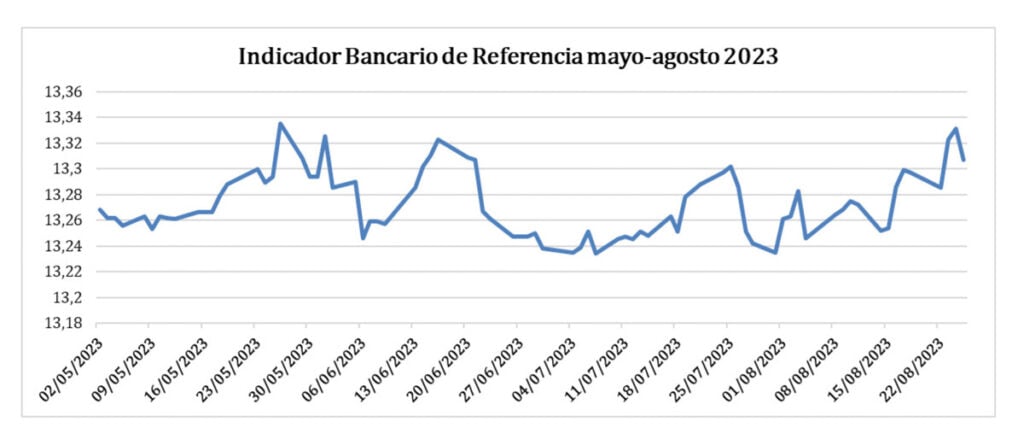
Where it is best to see if banks follow the decisions of the Central Bank is in the Reference Banking Indicator (IBR). The IBR follows the behavior of the decisions made by the Board of Directors on the reference interest rate. In this way, the IBR reflects the movements of the monetary policy.
The IBR reflects the interest rate at which the eight banks that provide the information to construct the indicator are willing to lend and borrow money: Banco Agrario, Banco de Bogotá, Davivienda, Bancolombia, Banco de Occidente, BBVA, GNB Sudameris and ITAÚ. In this sense, the IBR is a rate that serves as a reference to measure the cost of money in Colombia.
Since the last increase in the reference interest rate of Banco de la República, in April 2023, the IBR has shown a stable behavior, which has not moved away from the reference rate of 13.25% (Graph 1).
This means that, at least for now, there is no pressure from banks to raise the interest rate. Thus, decisions remain in the hands of the central bank’s board of directors and in the complementary decisions taken by the Government.
You may read: Overtime in Colombia: authorization now has to be renewed every six months
U.S. interest rate rises, pushing up rates in other countries
The U.S. Federal Reserve’s (FED) benchmark interest rate serves as a parameter for the entire world. It is common that, when it rises, so do the rates of emerging economies to avoid capital flight. This is a central point because interest rates have been rising for several years and further increases are not ruled out.
The U.S. benchmark interest rate was in the range of 0% to 0.25% in 2005. As of August 2023, following the latest 25 basis point hike at the Fed’s July meeting, the U.S. benchmark rate is at 5.25% and 5.50%.
In recent statements, Fed chief Jerome Powell said that interest rates could continue to rise “if necessary” to control inflation.
The interest rate hike in the United States responds to an economic conception that considers inflation as the greatest risk of the economy and the interest rate as the main tool to control it, according to Miguel Angel Rodriguez, research coordinator of the Center for Labor Studies (Cedetrabajo).
Many emerging countries fall into the Fed’s game
Rodríguez considers that “raising the interest rate to control inflation leads to paralyzing the economy and hitting employment. Moreover, in developing countries, where inflation is very sensitive to external conditions, raising the local interest rate does not always manage to control price increases as expected”.
Despite the researcher’s contention, there are many countries, besides the United States, that continue to use the interest rate as the main tool for controlling inflation.
The Central Bank of Turkey raised the interest rate from 17.5% to 25% in August of this year, as reported by the same entity. The reasons were to combat inflation and prevent capital outflows from Turkey to developed countries.
Similarly, in Mexico, the interest rate has been rising. It went from 4% in 2021 to 11% in 2023. In this case, it has served to slow down the economy due to lower credit for companies, but it has not prevented families from continuing to get into debt.
From April to June 2023, Mexican companies lowered requests for financing with commercial banks. This means that companies are taking out fewer loans. On the contrary, from January to June 2023, consumer loans (which are for individuals) increased by 18% compared to the same semester of the previous year, according to the Mexican newspaper Milenio.
Not all countries act in the same way
Unlike the examples of Mexico and Turkey, there are other countries that are beginning to move away from the upward spiral generated by the decisions of the United States. An example of this was Chile, which lowered its interest rate by 100 basis points at the end of July, bringing it down to 10.25%.
Brazil did something similar at the beginning of August. Brazil reduced its interest rate by 50 basis points for the first time in three years, bringing it to 13.25%.
In fact, some analysts are already saying that “the interest rate reduction phase has begun in Latin America”, as stated by Germán Cristancho, economic research manager at Davivienda.
Keep reading: The trade deficit in the beverage industry is increasing, but there is export potential