Overcoming the pandemic and succumbing to inflation: the risk for thousands of cafeterias and restaurants offering healthy food

In terms of food, Bogota has changed a lot in the last two decades. Along with the cultural changes that the city has undergone, a wide variety of gastronomic proposals offering healthy food have emerged.
Thus, those bakeries that offer innovative and alternative products to the traditional white bread in all its versions have gained popularity, as have cafes that allow visitors to get closer to the coffee production of various regions of the country and restaurants that pay special attention to the quality of their supplies and the preparation of their meals.
| You may be interested in: Four threats loom over Colombia’s dairy industry, according to the president of Dignidad Ganadera
Azimos, a bakery, pastry shop, café, restaurant and health food store, was established 18 years ago in La Macarena neighborhood. It is a small bakery that decided not to use refined wheat flour as its main ingredient in its products.
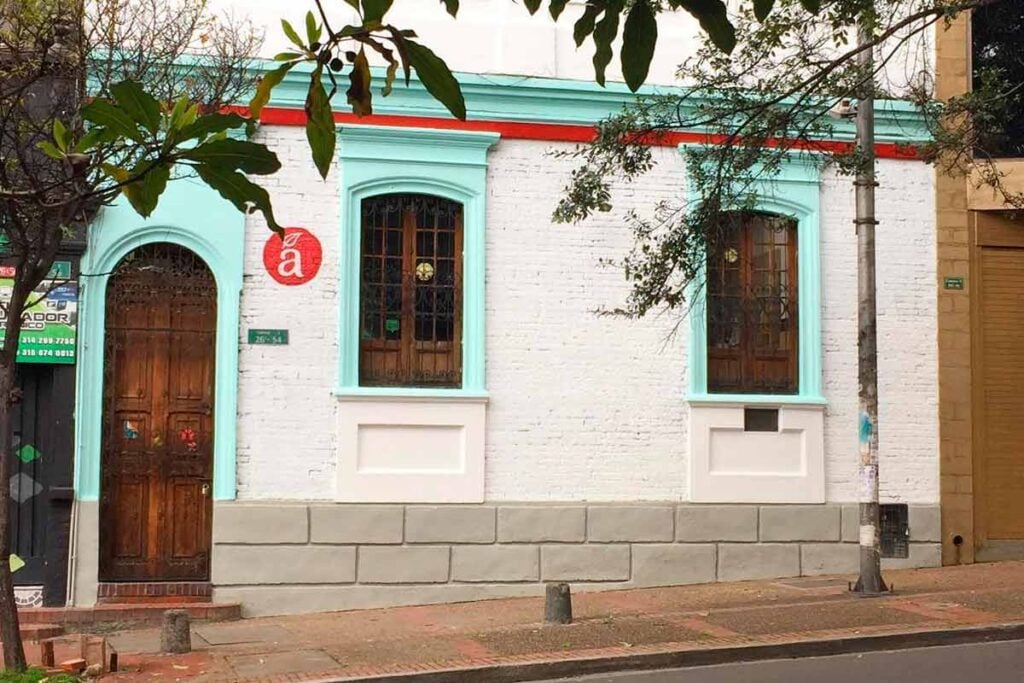
As a replacement, a wide range of bread made from whole wheat flour, but also from corn and rye flour, has been growing. In addition, from the beginning it offered its customers Colombian coffees and a restaurant that offers healthy, fresh and varied food on its menu.
This is one of the thousands of small Colombian businesses that managed to survive the difficult conditions of the pandemic, but that today face a situation that is perhaps even more difficult: inflation.
In 2022, the cost of living rose by 13.12%, but in the food item it reached a scandalous 27.81% (DANE) and 19% for restaurants, according to a study conducted by Cluvi and the Colombian Association of the Gastronomic Industry (Acodres) evidenced that restaurants raised their prices 19% that year. Although this year 2023 inflation has been a little lower, it is still strong and, what is worse, it accumulates to that of the two previous years.
We talked to Marcela Velasquez, owner of Azimos, who took us through the history of her business, the health food market, the challenges involved in maintaining a menu with quality ingredients, the current economic outlook for micro-enterprises and the challenges for the future.

Eighteen years ago, you founded Azimos, the famous bakery and health food restaurant in Bogotá’s La Macarena neighborhood. Where did the name come from?
The name comes from the unleavened bread, which was the first bread known. This bread was made with flour, whole wheat flour at the time, water and cooked over a fire.
That is where our name comes from, which alludes to the origin, to the beginning. And, from unleavened bread, we changed it to Azimos. We must remember that we started as a bakery.
Bogota has a long baking tradition and the neighborhood bakeries, very focused on white and soft bread, have a solid clientele. What led you to found Azimos and why did you decide to change that concept?
More than 18 years ago, when I arrived from Spain, I realized that in Colombia we had a great lack of bakeries, because most of the breads that were sold were white breads of very poor quality.
Although they tasted very good, those breads hurt me a lot because they inflamed my stomach. So, I realized that I had to start making a different kind of bread.
Motivated also by my love for bakery, and taking advantage of the fact that in Spain I studied a bit of this trade, I decided to open Azimos.
What kind of bread did you decide to make?
I started working with whole wheat flour, something that almost nobody did. I also innovated with other flours that we have here: corn flour, sago flour and rye flour, which is more German but also available here.
I realized that bread can be very tasty, healthier and varied. That was the reason why I decided to start a bakery with different breads: to teach people, through our breads, that whole wheat bread and bread made with other flours can be very tasty, healthy and pleasant breads.
Before, almost 20 years ago, people thought that whole wheat bread was a hard bread that looked like a stone, and it really wasn’t. A whole wheat bread can be soft, rich and tasty. A whole wheat bread can be soft, rich and healthy.
Has the consumption of bread changed massively in Bogotá or is it more of a neighborhood dynamic or of certain customers?
I think that bread consumption in Bogota has changed a lot. Compared to 20 years ago, it has changed a lot. Although we still have the traditional bakeries, which are dedicated to soft, white bread, we are seeing more and more bakeries with natural breads, sourdoughs and alternative flours, such as rye, corn and quinoa. And people like it.
Customers have also understood that there are often breads that are too heavy for them and that they have to change. For example, I receive many customers whose doctors have forbidden them to eat white bread.
Besides, white bread is not very good for children. Let’s remember that the problem with white bread is the flour refining process. It has many chemicals and sub-processes that are bad for health and that ultimately do not provide any nutrients.
So I think that yes, people are becoming more and more aware and are looking for this type of bakeries, and there are more and more of them in Bogota. I don’t know about other cities, but at least in Bogota.
| You may also be interested in: The rice sector is on tenterhooks: no agreement was reached and the mobilization for storage incentive and floor prices is maintained
How do you make “healthy” breads taste good?
We had a misconception – and many people still do – that healthy tastes ugly. It doesn’t.
It is simply a matter of having good preparation techniques, high quality ingredients and committed workers. For that we have always counted on very good bakers, who know their job and who know that their trade is almost an art.
Combining these aspects, we obtain a healthy, good quality and great tasting bread.
Why did you decide to make the leap from bakery to bakery and restaurant? What have been the biggest challenges of growing?
From a bakery and pastry shop, we made the leap to a café and then to a restaurant. This has been a little thanks to the dynamics of the neighborhood.
Since we arrived in La Macarena, we have always had a very good reception with our products. People wanted to drink coffee in the bakery, so I put a coffee machine there. The clients had a very small space, with four chairs, and they almost started to reserve it. So we said, “No, let’s put in a bigger café”. And we did very well with the people from the neighborhood and from other neighborhoods.
Then, we started to have a very basic kind of lunch, based on pastry products such as quiche, salt pastries, Chilean empanadas and Colombian empanadas, but baked.
This was very well received. We saw that people in the neighborhood wanted to eat there, wanted to have lunch and were looking for more options with healthy food to eat in the neighborhood. The neighbors wanted a tasty, healthy, different lunch.
At that time, we decided to move to a slightly larger location and set up a healthy restaurant. The reception was very positive.

Which products have been losing interest and which, on the contrary, have increased their clientele?
I think that in general all organic, healthy and nutritious products have been gaining interest in the population.
I see that what was previously understood as “healthy” has lost interest, but was not. For example, vegetarian products made with soy, which some time ago were basically the only option for vegetarians to consume.
Today, it is now known that there are many more nutritious options for vegetarians. In fact, soy products need to be treated with caution because soy requires a lot of chemicals in their cultivation and they are genetically modified seeds.
These are the only products in which I have seen a loss of interest: tofu and soy products.
Otherwise, I feel that all the health foods, such as vegetarian, gluten-free and organic products, have become more and more popular. People understand them more and consume them more.
Let’s talk about the ingredients, where do the ingredients you use to prepare your bakery products come from?
In the restaurant we work with local, nearby and seasonal products and suppliers. That was one of our principles. We also work with the organic products we can get to achieve a local, healthy, artisanal dish that meets all the nutritional requirements for a day in Bogota. That has been our goal at the restaurant.
I can say that there is a little bit of everything. What we can get locally and organically we buy that way, like tomatoes, certain vegetables and flours.
But sometimes there are products that definitely have to be imported, such as olive oil. Domestic flour is not of very good quality, so we have to buy Canadian flour.
| You may be interested: The decision to migrate: more than 2% of the world’s population are migrants and refugees
What inputs are not available organically?
For large productions like ours -because we make a lot of bread and pastry products- we cannot find, for example, organic flour or butter, because they are not being made in large quantities.
We are not able to find all the organic inputs, sometimes they are available in small quantities and at very high prices, conditions that we cannot work with either. So, organic inputs are used more for small things.
Unfortunately, people who are trying to produce organic food do not have much support. It is not easy for them, so they are mostly small and very artisanal productions. It is not like in Europe, which has large organic companies and receive support from the state.
In Colombia there are many companies that struggle and struggle to get ahead and do not succeed. I have seen over the years many companies of organic producers that do not manage to continue and decide to close.
How much have inputs and other production costs become more expensive?
Actually, inflation in the last year and a half has been terrible. That is to say, it has hit our costs very hard, it has hit our companies very hard.
And I believe that if this does not stabilize in the course of this year, many companies will be forced to close, because at this moment many costs are not being covered and we cannot raise prices any more.
What we companies are doing is reducing profits and trying to stay on the edge, hoping that this will stabilize, but we can’t hold out much longer.
In addition, we see that food prices are going up, but they are unlikely to go down again. This has happened especially in proteins. Yes, lemons have gone down, potatoes have gone down, but in reality the main costs, which are often proteins, do not go down.
There is also a problem with labor, which is not stable. Yes, we have been very affected and I believe that if during the course of this year it does not stabilize, many restaurants and gastronomic places will be forced to close their doors.
How have you dealt with this situation and what impact have the costs had on the commercialization of the products?
As I was saying, what we have done at the moment is to reduce the company’s profits. We are almost working at zero profit, keeping the people, keeping the company, simply to endure the economic situation for the moment and with the hope that it will improve. But we are not giving any more.
How easy is Colombia when it comes to creating a business?
Growing as a business is not easy, it is not easy in this country. It is achieved little by little, but it is really a challenge. It is a test of entrepreneurship and tenacity that one must have to be able to form a company in this country. There is a difficult tax issue.
In addition, we had that hard blow of the pandemic. Although we had subsidies from the district and the government for a while, which helped me a lot, it was very difficult. I feel that we are just coming out of that crisis. It is difficult to grow; you can, but it is not easy.
What are the biggest challenges you foresee for the coming years?
There are several challenges for the future. One is, for now, to put up with the situation and wait to see what happens with public policies, laws, labor and tax regulations, hoping that there will really be a favor, a help, a contribution for us, the SMEs and MSMEs, which are very small companies, which are generating between 4 and 15 jobs and we are little taken into account.
It is a bit like waiting for what is going to happen with this and according to that we will see what path we are going to take.
We also have to see what is happening with people’s consumption. I believe that this issue of awareness of healthy food consumption is going to become more and more important. The challenge is to provide more quality, more healthy and nutritious products for the people of Bogota and Colombia.
Another challenge is to apply new technologies, to move forward with technology. We cannot forget it: social networks, orders, home delivery. We must rely on all the technology, and also be able to get closer to the new generations.
These are all challenges. To be very aware of the market so as not to leave, and rather to be always present, improving and adapting.
| Read more: Slavery and child labor one year after the G7 Elmau pledge