Paloma Valencia says teachers’ strike against school vouchers is a “kind of extortion”: there is a tough survey

Senator Paloma Valencia, of the Centro Democrático political party and author of the school voucher bill, published a harsh message on her official X account, the social network formerly known as Twitter, in which she accuses Fecode of being doing “a kind of extortion” with the national teachers’ strike called for August 30.
El éxito del bono escolar
— Paloma Valencia L (@PalomaValenciaL) August 28, 2023
Fecode anunció un paro nacional contra mi proyecto de Bono Escolar que tendrá su segundo debate en el Congreso. Es una especie de extorsión: si aprueban el proyecto los niños del sistema público no tendrán clases. Me parece que reafirma la importancia…
The teachers’ strike has as one of its main demands the withdrawal of the bill that Valencia is leading in the Congress of the Republic. CNA Practice Test
You may read: Attention: FOMAG reforms teachers’ health care system
This project proposes the creation of so-called school vouchers, which are nothing more than vouchers or checks that would be given to parents of school-age children to cover school costs -or part of them- in certain private schools. A strategy that aims to alleviate the costs of education in order to better prepare students academically. This is also the purpose of the CNA Practice Test.
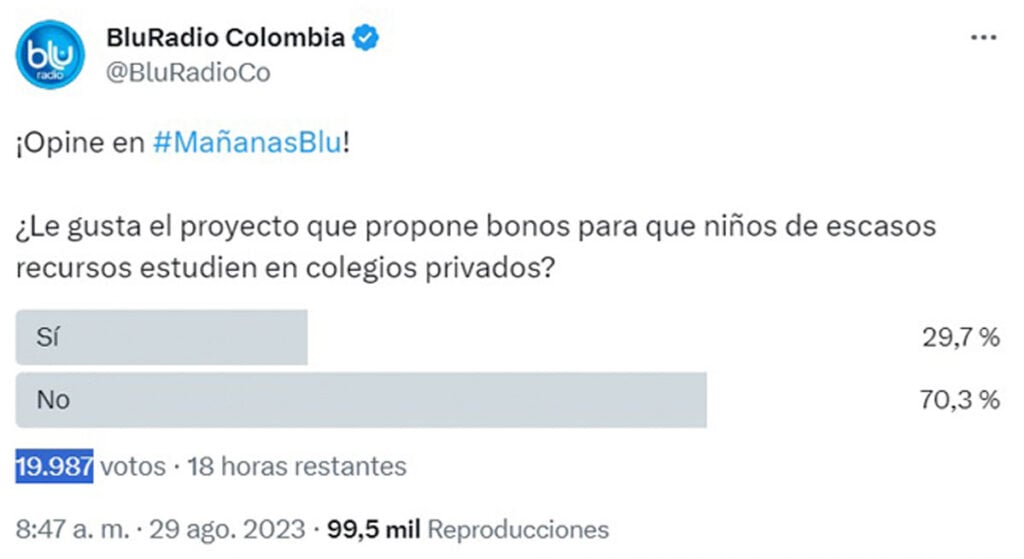
Well, school vouchers ended up at the center of a strong controversy between detractors and supporters, when Mañanas Blu conducted a tough poll on the subject, in which you can still vote.
In the poll it asks its users, without giving any prior context, if “Do you like the project that proposes vouchers for low-income children to study in private schools?”
So far, 70.3% of respondents have said no, and the remaining 29.7% have said yes, for a total of 19,987 votes.¡Opine en #MañanasBlu!
— BluRadio Colombia (@BluRadioCo) August 29, 2023
¿Le gusta el proyecto que propone bonos para que niños de escasos recursos estudien en colegios privados?
What does the Bill on school vouchers say?
Bill 192 of 2022, “whereby the school voucher is created in Colombia and other provisions are issued”, has the following purpose:
“To create the program of ‘School Vouchers’ defined as the voucher or check that delivers and finances the Colombian State to parents, or those who exercise parental authority, so that children and adolescents in condition of vulnerability, moderate poverty or extreme poverty so that [sic] they can access preschool, basic and middle school education in public or private educational institutions”.
Why does Fecode reject the school vouchers project?
The concern expressed by Fecode is that the implementation of school vouchers could lead to a privatization of public education.
This insists María Antonieta Cano, coordinator of Fecode’s national gender team, who affirms that the school vouchers would no longer guarantee public education, universal and with infrastructure administered and financed by the State.
You may also read: The magisterial teachers’ competition is in the final stretch: all about the composition of the list of eligible candidates
According to Professor Cano, this privatization is manifested in the fact that, first, the school vouchers would continue on the path of reducing spending on education. Second, the teachers of these private schools would not be included in either of the two labor regimes of the teaching profession, with the result that the labor rights of this sector would gradually disappear.
Fecode also argues that by allowing public resources to be used to finance education in private or subsidized institutions, the inequality gaps that public education has contributed to reduce over the years could increase.
The union claims that the vouchers would not cover the costs of high quality private schools, characterized by high tuition and pension costs, but would be destined to cheap private schools, known as “garage schools”.
For Fecode, what the school voucher project really seeks is the creation of “charter schools”, the granting of educational vouchers (also known as school vouchers) or the use of public funds to finance private education.
The concept of charter schools and educational vouchers are little known in Colombia, although they have a long history in other countries.
Charter schools and vouchers: two long-standing models
- Charter schools
Charter schools are a type of educational institution that originated in the United States in the 1990s, and have been implemented with variations in other countries.
- Granting of Educational Vouchers or School Vouchers
Educational vouchers, also known as school vouchers or educational checks, are a form of financing in which public resources are allocated to the parents or guardians of students instead of directly allocating funds to educational institutions.
In this way, they constitute a form of demand-side financing, to the detriment of supply-side financing.
Arguments for and against school vouchers
The debate on the convenience of school vouchers is far from over. For Senator Valencia, “it is a matter of poor and vulnerable parents being able to choose between public school and a private school for their children paid by the State”.
For Fecode, school vouchers could weaken the public education system, concentrate resources in private institutions and create inequalities in access to education.
At the heart of the debate is whether education is a fundamental right that should be provided, financed and regulated by the State to guarantee equal opportunities, or whether there should be more flexibility for families to choose different educational options.
Also, it remains to be defined whether the institutions eligible to redeem the vouchers would be subject to regulations and standards similar to those of public schools.
Keep reading: Water cuts in Bogota today