Petro’s government relaxes position and strengthens cooperation with U.S. after Kristi Noem’s visit
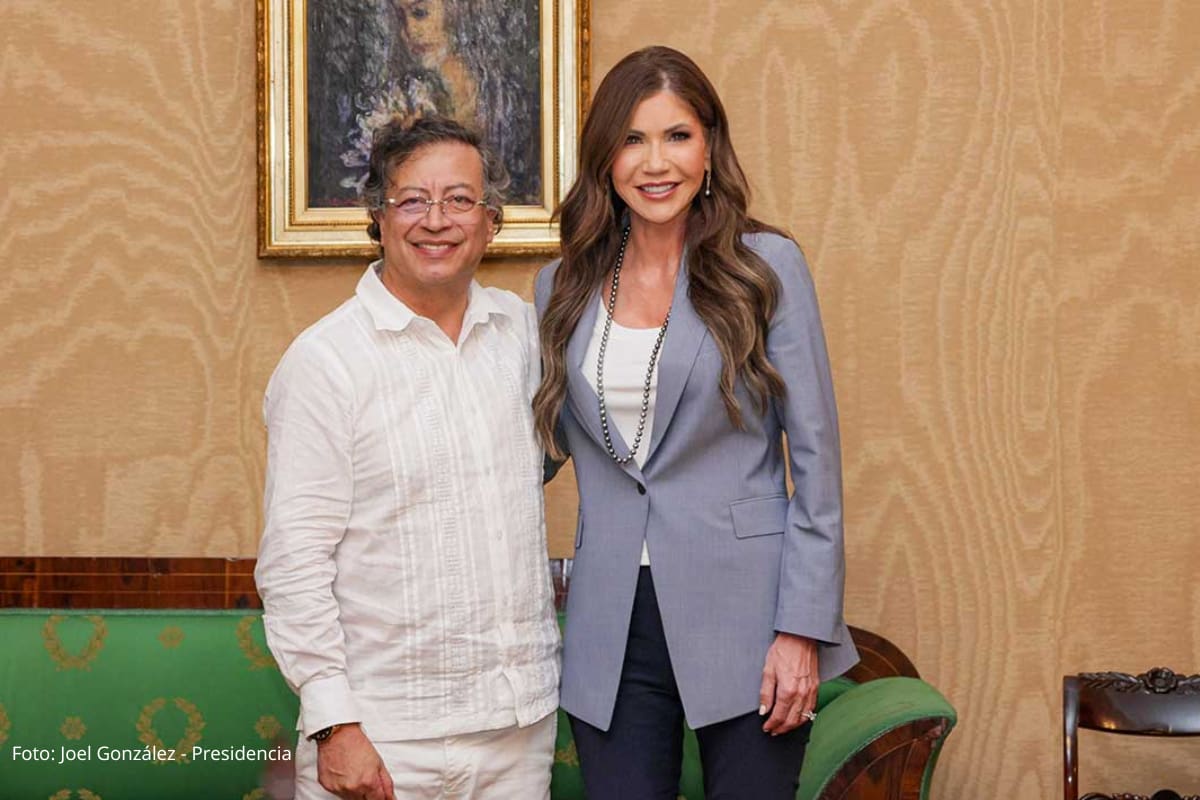
President Gustavo Petro has shown a change of stance towards Donald Trump’s administration, with the visit of Homeland Security Secretary Kristi Noem.
The rapprochement is also reflected in Petro’s recent decision to accept migrants returned from the United States in an effort to jointly manage the migratory flow.
All this takes place in a context of increasing pressure, given the risk of a possible decertification of Colombia by the United States due to the fight against drug trafficking, which could imply a drastic reduction in the economic aid and international funding that the country receives.
You may read: Colombia facing Trump’s tariffs: drop in sales and lower competitiveness
Kristi Noem, Secretary of Homeland Security on tour of Latin America
Kristi Noem, U.S. Secretary of Homeland Security, toured Latin America in March 2025, visiting El Salvador, Colombia and Mexico.
In El Salvador, on March 26, Noem toured the Terrorism Confinement Center (CECOT), a maximum security prison, with the Minister of Justice, Gustavo Villatoro. During his visit, he threatened illegal migrants about the consequences of entering the United States, noting that they could end up in prisons like the one in El Salvador.
He also signed a memorandum of cooperation for the exchange of information and fugitive files between the two countries.
On March 27, Noem arrived in Colombia, where he met with President Gustavo Petro and other high-ranking officials. During his stay, an agreement was announced to deploy biometric capabilities to manage migration and combat criminal activities, strengthening collaboration between the two nations on regional security.
The tour concluded in Mexico on March 28, where Kristi Noem held high-level meetings with President Claudia Sheinbaum and Foreign Affairs Secretary Juan Ramon De La Fuente. Discussions focused on immigration, crime and deportation issues.

Migration and drug trafficking: key issues during the visit of the U.S. Secretary of Homeland Security to Colombia
During the visit, the Secretary of Homeland Security met with Foreign Minister Laura Sarabia at the San Carlos Palace, headquarters of the Colombian Ministry of Foreign Affairs. During this meeting, the officials signed a letter of intent to implement a biometric data exchange program, with the objective of strengthening the management of migratory information and combating illicit activities.
In addition to her meeting with the Foreign Minister, Noem held a meeting with President Gustavo Petro at the Casa de Nariño. Discussions focused on issues of public security, drug trafficking and human trafficking, evidencing the mutual commitment to address shared challenges in the region.
The signing of the agreement on the exchange of biometric data seeks to improve both countries’ ability to identify and apprehend individuals involved in criminal activities that cross borders. This mechanism has already facilitated more than 1,700 deportations and 1,000 arrests, according to Kristi Noem.
This visit also marked a détente in relations between the governments of Donald Trump and Gustavo Petro, which had previously faced tensions due to disagreements over migrant repatriation flights. Colombia’s willingness to accept these flights and the signing of the new agreement reflect a willingness to cooperate on the part of President Gustavo Petro.

You may also read: China, Japan, South Korea seek to counter Trump’s tariffs with trilateral deal
Petro travels to Panama and agrees to receive migrants
Colombia’s President Gustavo Petro made an official visit to Panama from March 28-29, 2025. On March 28, Petro met at the Palacio de las Garzas with his Panamanian counterpart, José Raúl Mulino. During the meeting, the main topics discussed were the management of migratory flows, the fight against transnational organized crime and cooperation in security matters.
At the meeting, Petro agreed to receive migrants returned from the United States, pledging, along with other leaders, to jointly manage the reverse migratory flow.
On security, they recognized the threat of transnational criminal organizations and reaffirmed their commitment to the fight against drug trafficking and human trafficking.
On March 29, Petro visited the province of Bocas del Toro, where he was received by Governor Eddy Ibarra and Panamanian Foreign Minister Javier Martínez-Acha. Petro took advantage of the visit to pay tribute to the Colombian combatants who fell in the Thousand Days War and other conflicts of the 19th century, to place a wreath at the statue of Simón Bolívar, and to tour historical sites such as the Fire Station and the old cemetery of Bocas del Toro.
He also reiterated his request to the Panamanian government to exhume the bodies of Colombian workers who died during the construction of the Panama Canal, an initiative he had previously proposed in 2024.

Colombia at risk of decertification
The possible decertification of Colombia by the United States is part of the annual evaluation that the United States carries out on cooperation in the fight against drug trafficking. Decertification could occur if Colombia is deemed not to have adequately complied with its commitments in this area.
The fear arises from the 10% increase in hectares planted with coca in 2023, presented in October last year in the latest report of the United Nations Office on Drugs and Crime (UNODC). As well as the disagreements between Petro and Trump.
In this regard, Colombian Foreign Minister Laura Sarabia has indicated that the government is preparing for various scenarios, including both certification and decertification. Although she considers decertification a hypothetical scenario, she emphasizes that the country is taking steps to demonstrate its commitment to the fight against illicit crops.
A possible decertification could have significant consequences for Colombia, such as a reduction in economic aid from the United States, trade restrictions and difficulties in accessing international financing.
https://mascolombia.com/en/ecopetrol-cuts-dividends-tension-expected-at-shareholders-meeting/