Design thinking is a valuable tool in project management, specifically in the development of patents

Patricia Téllez Chavarro
Magíster en gerencia de la innovación empresarial, especialista en Propiedad Industrial, derechos de autor y nuevas tecnologías, e ingeniera química. Coordinadora de Patentes de la Firma Muñoz Abogados.
Project management has currently emphasized the application of agile methodologies to show progress during execution. The best known is SCRUM (management process that reduces complexity in product development to meet customer needs), however, in the creation of new products or procedures Design Thinking has stood out among these methodologies because it focuses on the problems or customer needs, which focused on a technical problem can provide novel and inventive solutions, with potential for protection as patents.
To begin with, it is important to be clear about the concept of Design Thinking, among others, the most appropriate or closest is the one indicated by Serrano & Blázquez that indicates, “(…) it is a way to solve problems reducing risks and increasing the chances of success. It starts by focusing on human needs and, from there, observes, creates prototypes and tests them, manages to connect knowledge from various disciplines (psychology, sociology, marketing, engineering…) to reach a solution that is humanly desirable, technically feasible and economically profitable”.
| You may be interested in: Certificates of Deposit: Are CDs FDIC insured?
From the above definition we can highlight certain words and interrelate them with project management and see how the application of this tool is not far from giving a light to generate innovative ways of directing and making decisions in project management.
This is how it starts with the phrase “way to solve problems”, which may be the initial question of those interested in a project, since this is an idea of something that is intended to be done and for which a certain way and a set of necessary means are established, so that the need or problem is solved.
Now, we continue with “risk”, a word so usual in traditional project management, where the manager seeks to minimize it at all costs through planning, forecasting and control, however, it is always based on logical or rational thinking for its solution without allowing the emergence of new solutions given by lateral or creative thinking, which Design Thinking allows.
Another point of convergence is when it is indicated that Design Thinking follows stages given in its definition such as, “observe, create prototypes and test them”, which can be assimilated to project phases such as initiation-planning, execution, monitoring, but which must be reevaluated with the Design Thinking tool to find solutions with tolerable ambiguity (lack of understanding) and uncertainty (lack of data).
Also, the need for knowledge connection indicated in the definition of Design Thinking is supported by the chaos theory indicated by Mulder, 2012 in Dijksterhuis1 (2016) in project management, as this theory indicates that complex, ambiguous or uncertain projects can be worked on when concepts such as those focused on “social”, “motivation”, “value creation” and “trust building” among project participants and stakeholders are applied.
Continuing with the final part of the definition of Design Thinking which indicates that it seeks “a desirable, technically feasible and economically profitable solution”, nothing closer to what is also sought in project management, where if the project is not profitable it is not justified to start it even if it is feasible.
| You may also be interested in: Colombia, a preferred destination for startups around the world: What does the country offer to emerging companies?
Thus, the value of the Design Thinking methodology in project management can only be evidenced if it is accepted that it is possible to rethink problems by creating new and interesting frameworks. Although it is important to base the solution of problems on the experience acquired, it should not be forgotten that these solutions originated from particular conditions, and that it may be better when Design Thinking is applied to observe-think-act in the day-to-day management of projects, since it allows all project members and stakeholders to make contributions that give agility to the development of the project.
As can be seen, the approach to project management based on Design Thinking allows the project manager to have a connection with customers and stakeholders to analyze the entire environment of the problem posed and have an objective and subjective criteria to design the goals and activities of the project, which has an impact on improving the processing of information and response time, reducing losses during the execution of the project.
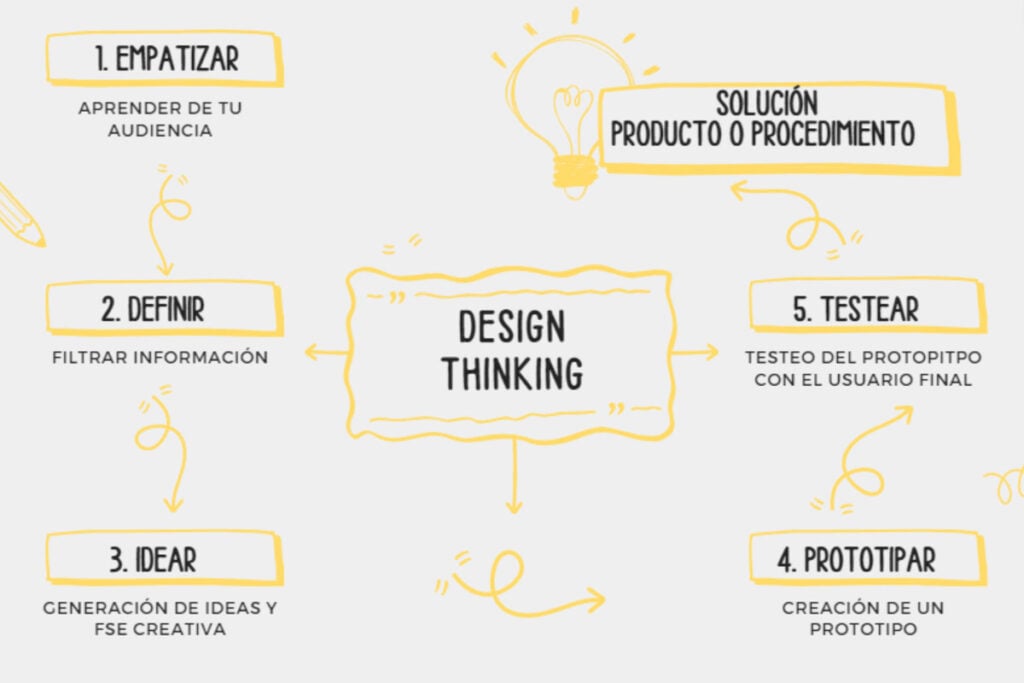
Among the success stories of Design Thinking, which employed the Project Management strategy, we can mention, among others, the Airbnb Company, which in 2009 did not reach revenues of more than USD $800 per month.
Thus, by applying the five phases of the Design Thinking process, this company started to become what it is today, where in 2022 it closed with profits of USD $1,893 million.
Another example is SAP SE2, the management software and ERP giant, which has been one of the companies most closely linked to Design Thinking, so much so that Hasso Plattner, one of its leaders, founded the Design Thinking Institute based at Stanford University, the Hasso Plattner Stanford Institute of Design, known as d.school, which, according to the New York Times, has become one of the most sought-after academic programs at Stanford.
In Colombia, we have as an example of the application of the Design Thinking process related to Industrial Property, the patent No. NC2019/0008460 entitled, “Teaching device for disabled people”, which was a field work project that applied the Design Thinking methodology to delve into the problems or needs of users and their solution in a novel and inventive way.
According to the above, and taking into account this last example, the Design Thinking methodology has application in all the processes of a company, but undoubtedly even more in the R+D+i processes, where it is necessary to invent and innovate with new products and procedures to have an advantage in an increasingly competitive market.
In fact, the inventive processes start with an unsolved technical problem and reach the solution of the same, being these the step 1 and step 5 of the Design Thinking methodology.
In the middle of this methodology is step 2, which requires information inputs both from the environment and current technologies, however, not enough for the new challenge, it is essential to have as a source of information the results of technology watch, review trends and competitive intelligence to know how the problem has been solved or what competitors are doing to overcome this technical drawback and correctly define the challenge.
In step 3, ideation, the greatest possible number of solutions is sought using creativity techniques, where the ideas with the greatest potential for success are evaluated for their novelty and inventiveness.
Prototyping, step 4, is where a tangible product is designed or the stages and conditions of the procedure that can give us information for improvement or final discarding.
In the final stage of testing, real performance data is obtained, which will show the real advantages or disadvantages of the selected solutions.
Then, as a final recommendation, it should not be forgotten that if in this last stage unexpected results are obtained, it is important to protect the result, which, depending on the nature of the product, may be by patent or industrial design, because although Design Thinking reduces time and resource costs, it involves a whole intellectual process, which is unique to each case, and protecting it prevents others from taking advantage of the solution found without the owner’s permission.
–
1 Dijksterhuis Eva, Silvius Gilbert (2016). The Design Thinking approach to projects. PM World Journal. Vol. V, Issue VI-June.
2 The name is an acronym for the company’s original German name: Systemanalyse Programmentwicklung, which translates as “system analysis software development”. Today, the company’s legal corporate name is SAP SE – SE stands for “Societas Europaea”, a public company registered under European Union corporate law.
Are evolutionism and Darwinism the same thing?