Exports of cape gooseberry exceed 8,000 tons in 2022

The cape gooseberry is a fruit native to South America that is characterized by its sweet flavor with acidic touches. Although it is not so well known abroad for being an exotic fruit, uchuva exports have been growing thanks to its versatility—it can be eaten alone, in juices and in all kinds of desserts—and durability.
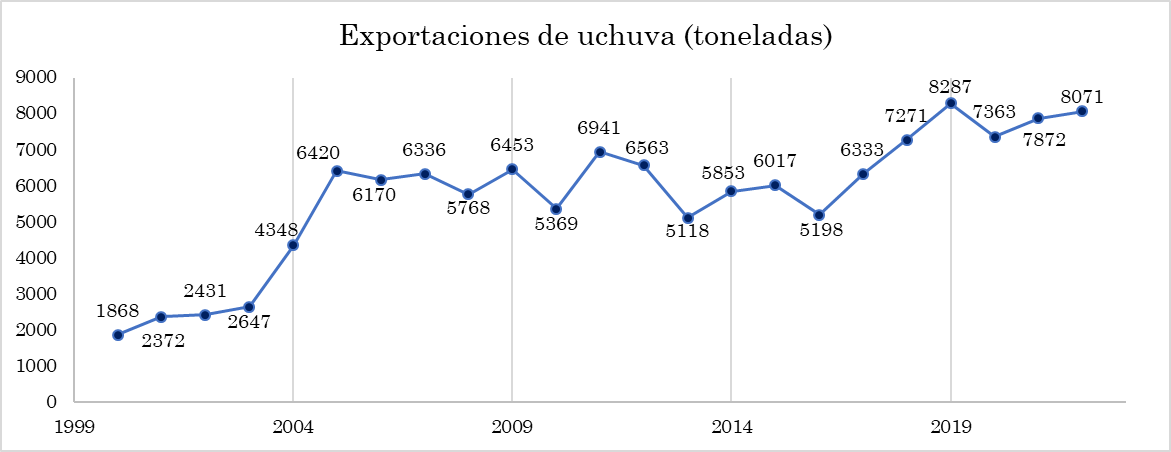
Since 2000, cape gooseberry exports have shown a positive trend. While in 2000, 1,868 tons were exported, in 2022 they reached 8,071 tons, according to DANE figures. This means that they have multiplied more than four times.
You may read: 10 Things to Know About Rocket Money
The evolution of cape gooseberry exports
Prior to 1998, uchuva exports did not even reach 1,000 tons. The year 1999 was a transition year for the great growth that took place in 2000.
The turn of the century, with its renewed interest in healthy eating and exotic fruits, was very positive. Since that time, there has been a growing trend of cape gooseberry exports, as shown by the fact that in 2001 foreign sales already reached 2,372 tons.
The average annual growth of uchuva exports from 2001 to 2022 was 8.6%. The years in which they grew the most were 2004 (64%) and 2005 (47%). More recently, the growth of 2017 (21%) and the fact that they continued to increase in 2018 and 2019, as shown by DANE figures, stand out.
In the course of those 22 years, between 2001 and 2022, there have been drops in tons exported in seven years. The sharpest was in 2013, when uchuva exports fell 22% compared to the previous year. The most recent decline was in 2020, with a reduction of 11%. Despite these bad years, in 2022 external sales recovered, although they failed to reach those of 2019, before the pandemic.
The main destinations for uchuva exports have been the Netherlands and Germany, while the following countries have been changing. Between 2001 and 2011, the Netherlands accounted for 42% of the cape gooseberries sold abroad. The second place went to Germany, which bought 26%. It was followed by Belgium (12%), Sweden (5%), France (4%) and the United Kingdom (3%), according to DANE calculations.
You may also read: Naval innovation 100% Colombian: this is Cotecmar, the company that builds the National Navy’s ships
The latter countries have lost share in recent times. From 2012 to 2021, the Netherlands and Germany continue to be the main destinations. But in these years, the United States has become the third destination, with a share of 6% of exported tons. Belgium moved to fourth place, with a weight of 5%, and Canada ranked fifth with 4%.
Exports of cape gooseberry also grew in 2022
Exports of uchuva reached 8,071 tons in 2022. That year the second best historical record was achieved, only surpassed by 2019 exports, when they stood at 8,287 tons, according to DANE. The 2022 tons do show growth with respect to 2020 and 2021.
In 2022, uchuva exports went to 26 different countries. The Netherlands imported almost 69% of the total, with 5,544 tons. The United States followed, with a demand of 1,353 tons, equivalent to a little less than 17% of all exports, so that between these two countries they bought approximately 85% of the cape gooseberries sold abroad.
How cape go the cape gooseberry exports in 2023
In 2023, as of August 30, cape gooseberry exports totaled 5,544 tons. This year they have been shipped to 21 different countries. The first two places remain stable. To the Netherlands have gone 64% of the cape gooseberries, or 3,536 tons. The second place is the United States with 951 tons, 17% of total exports.
There are currently 36 Colombian companies that export cape gooseberries, according to the Colombian Agricultural Institute. The departments that produce most of this fruit are Cundinamarca, Boyacá, Antioquia and Nariño. One of the achievements that stand out so far this year is the export of a shipment to Mexico, according to the same institute.
About 70% of workers in Colombia desire to change jobs and are actively looking for a new one