Home » Colombian Exports » Terms of Trade: a thermometer of economic prosperity in Latin America and the Caribbean
Terms of Trade: a thermometer of economic prosperity in Latin America and the Caribbean
According to ECLAC, more than 25 countries in Latin America will experience a negative impact on their Terms of Trade in 2022. Find out how this figure can have a profound effect on their economy and the financial stability of the region.
Terms of Trade represent the relationship between a country’s export and import prices, which is essential to understand economic health in its global interaction. For countries such as Colombia, Chile and Peru, research such as that of Camilo Cardenas and Maria Alejandra Prieto in 2015 reveals their direct impact on financial well-being.
Imagine the Terms of Trade as a thermometer of our economy in the world. If the prices of what we export go up compared to what we import, we have more money available to spend!
But if prices become unfavorable and what we buy becomes more expensive than what we sell, we have to tighten our belts and we have less money in our pockets.
The latest annual report of the Economic Commission for Latin America and the Caribbean (ECLAC) estimates an adverse effect of more than USD $60 billion on the region’s Terms of Trade in 2022, due to the global economic slowdown and the conflict in Ukraine. This will affect hydrocarbon exporting countries unevenly.
Terms of trade in the region do not show good signs
Terms of trade have a great impact on investment and economic growth in an economy. When they fall, investment decreases, which can negatively affect the economy and the ability of companies to obtain financing. It can also increase financial risk and make it more expensive to borrow money.
An alarming fact in the ECLAC report is that 25 of the 33 countries in the region saw their terms of trade turn negative in 2022, meaning that the price of what they bought increased faster than what they sold. This was due to price increases in food, fuel and fertilizer since 2021, exacerbated by the conflict in Ukraine.
Colombia sees sharp deterioration in its terms of trade
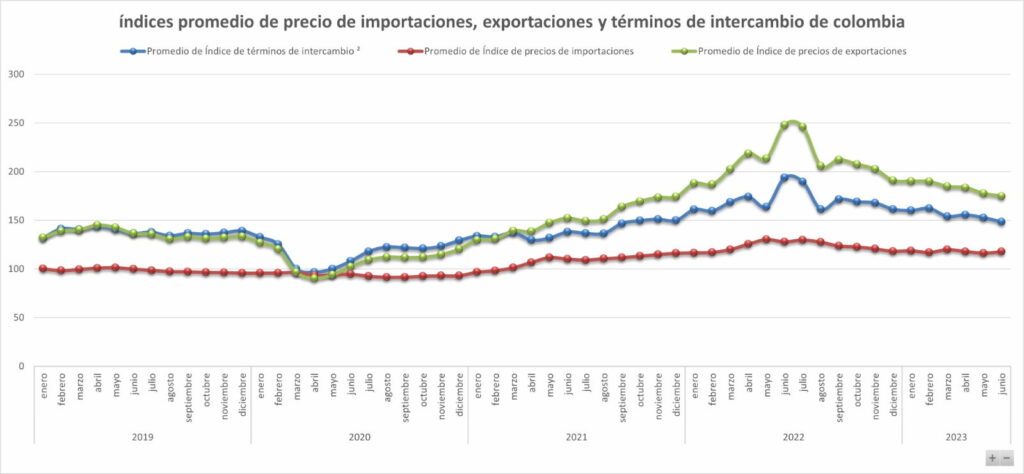
Colombia saw a significant improvement in its terms of trade thanks to the performance of oil and coal prices until mid-2022. However, since July 2022, the value of Colombian exports declined at a much faster rate than the reduction in the value of imports.
Source: Elaboration with data from Banco de la República
The deteriorating trend in Colombia’s terms of trade is worrisome and confirms that the Colombian economy is cooling and will face severe difficulties in the coming months.
Exports from Latin America and the Caribbean slow down
With the exception of Paraguay, all countries in the region experienced growth in the value of their exports. The ECLAC report reveals that the increase in the energy price index accounted for much of the 29.8% growth in the value of the region’s commodity exports between January and August 2022.
According to ECLAC estimates, during 2022 the price index for agricultural products grew by 20.9%, while the price index for minerals and metals remained virtually unchanged. As a result, the Commission estimated a 22.8% growth in the general price index of products exported by Latin America for 2022.
Although the recovery in the value of exports at the intraregional level (among Latin American and Caribbean countries) slowed in the second half of 2022, intraregional trade grew by 22% in the annual balance, which is good news for the region’s manufacturing exports.
As for the region’s trading partners, the report highlights that Latin American exports to the European Union experienced a 26% growth in value. For the first time since 2015, exports to China were the least dynamic, growing by only 8%, and sales to the United States were virtually unchanged.
During the first half of 2022, net hydrocarbon exporting countries benefited from a context of favorable prices in international markets. ECLAC projected a favorable situation for the value of exports from Trinidad and Tobago, Venezuela, Colombia, Guyana and Bolivia.
Imports from Latin America and the Caribbean continue to grow
In the case of imports, the report highlights that Central America is a net fuel importing sub-region, so the projected value of imports grew the most (31%) by 2022. In South America, ECLAC projected a growth in the value of imports of 25% in 2022.
ECLAC’s projected variation in the value of imports in 2022 is positive for all countries in the region. Colombia ranks 12th with an estimated import growth of 28%. Ecuador leads the list with 41% projected growth, followed by Suriname (40%), Jamaica (39%), Guatemala (38%), Honduras (37%) and Argentina (35%).
Utilizamos cookies esenciales para garantizar el correcto funcionamiento del sitio y cookies de terceros para elaborar información estadística y mostrarle publicidad personalizada.
Funcional
Always active
El almacenamiento o acceso técnico es estrictamente necesario para el propósito legítimo de permitir el uso de un servicio específico explícitamente solicitado por el abonado o usuario, o con el único propósito de llevar a cabo la transmisión de una comunicación a través de una red de comunicaciones electrónicas.
Preferencias
El almacenamiento o acceso técnico es necesario para la finalidad legítima de almacenar preferencias no solicitadas por el abonado o usuario.
Estadísticas
El almacenamiento o acceso técnico que es utilizado exclusivamente con fines estadísticos.El almacenamiento o acceso técnico que se utiliza exclusivamente con fines estadísticos anónimos. Sin un requerimiento, el cumplimiento voluntario por parte de tu proveedor de servicios de Internet, o los registros adicionales de un tercero, la información almacenada o recuperada sólo para este propósito no se puede utilizar para identificarte.
Marketing
El almacenamiento o acceso técnico es necesario para crear perfiles de usuario para enviar publicidad, o para rastrear al usuario en una web o en varias web con fines de marketing similares.