The biggest spider in the world and 9 more that are also huge
The spiders’ world is full of surprises. Feared by many, adored by others, these eight-legged creatures are certainly fascinating.
Here we’ll explore the facts behind the biggest spider in the world. From the rainforests of South America to the secluded caves of Southeast Asia, we’ll delve into the fascinating world of arachnids and uncover the secrets behind their impressive size and survival strategies.
You may read: 15 High Protein Snacks, portable and very nutritious
Buckle up as we embark on a quest to unravel the mysteries of the biggest spider in the world.
Keep reading to find out
What is the biggest spider in the world?
Goliath Birdeater: 12 Inches
With a mass of about 6.2 oz (175 g), the Goliath birdeater (Theraphosa blondi) is the biggest spider in the world.
This species has the ability to bite and occasionally sting with venom quite similar to a wasp sting. The strongest of its qualities are its barbed hairs, as they can snag on skin and eyes and cause itching and discomfort for days.
As suggested by its name, this spider occasionally consumes birds. It doesn’t feel particularly attracted to people. Yet, in some places, the biggest spider in the world is actually captured and cooked. Some even claim it has a shrimp-like taste.
Habitat: Usually, this spider can be found in burrows in northern South American marshes and jungles. You may keep it as a pet, as it does not really represent any danger.
Other giant spiders
Giant Huntsman Spider: 12 Inches
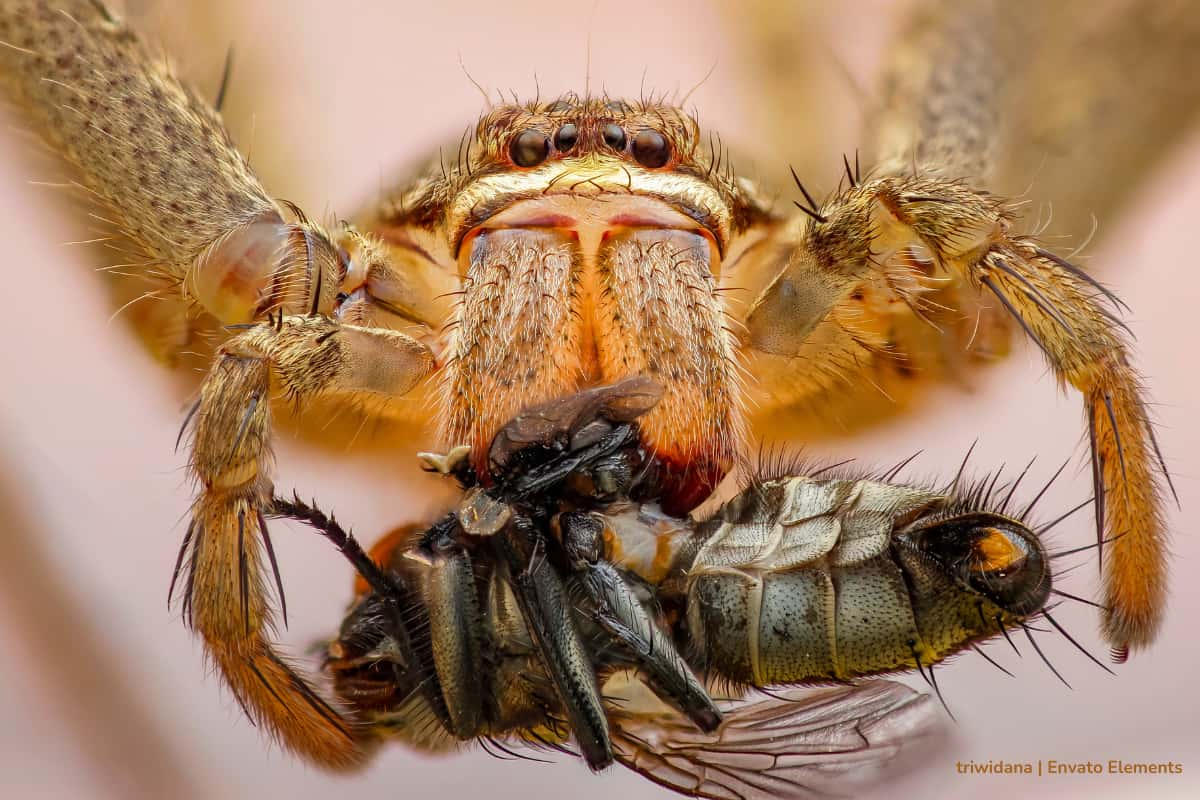
Although this is not the biggest spider in the world, it does possess longer legs and a larger build. The twisted position of its legs gives them a crab-like gait, making them easily identifiable.
These spiders are capable of biting with enough venom to warrant hospitalization. So watch out!
If you live in a warm environment, keep an ear out for the males’ regular ticking sound, which mimics a quartz clock. You can avoid male ticks by moving in the opposite direction, but female ticks are not audible.
Habitat: Although the gigantic huntsman spider is only known from a cave in Laos, you can find related enormous huntsman spiders all over the world in warm and temperate climates.
Brazilian Salmon Pink Birdeater: 11 Inches
Also called Lasiodora parahybana, this is the third biggest spider in the world. Just an inch smaller than the actual biggest spider in the world, females get to weigh around 100 grams more, while males have longer legs.
This sizable tarantula is docile and known to reproduce well in captivity. However, this spider has a strong bite, akin to a cat’s when provoked.
Habitat: The Brazilian forests are home to this species in the wild. But because it’s a well-liked captive animal, you might also encounter one at your neighbor’s house or in pet shops.
Grammostola anthracina: 10+ Inches
It’s not just the biggest spider in the world that lives in South America. Another quite large species is Grammastola anthracina. Unless you forget to give it mice or crickets to eat, this common pet tarantula won’t likely bite you. They can live for up to 20 years.
Habitat: This spider can be found in Argentina, Brazil, Paraguay, and Uruguay.
You may also read: Top 7 Ginger Tea Benefits: Boost your immune system
Colombian Giant Tarantula: 6-8 Inches
You may keep a Colombian giant tarantula to help with pest management, as it eats mice, lizards, and large insects.
Megaphobema is most well-known for its aggressive nature, though. You don’t need to be concerned about the bite, but keep an eye on its legs, as this spider may spin and strike with its spiked rear legs in response to actual or imagined danger.
Habitat: you can find this species either in the tropical rainforests of Brazil or Colombia, or even in pet stores.
Face-Sized Tarantula: 8 Inches
Although the biggest spider in the world —and some competitors— live in South America, you can for sure find huge creatures elsewhere.
The face-sized tarantula (Poecilotheria rajaei) has adapted to Sri Lanka’s deforestation by moving into abandoned structures.
Poecilotheria, its scientific name, translates from Greek as “spotted wild beast”, and it offers quite an explanatory definition, as this spider enjoys eating snakes, lizards, rodents, and even birds.
Habitat: India and Sri Lanka.
Hercules Baboon Spider: 8 Inches
This specimen was discovered in Nigeria around a century ago and is now kept at the Natural History Museum in London. Its name is a reference to a habit of devouring baboons—but not really. Its name actually refers to the similarity between its legs and a baboon’s fingers.
East Africa is home to the king baboon spider, Pelinobius muticus, which slowly reaches a height of 7.9 inches (20 cm). Another spider subfamily known as “baboon spiders” is the Harpactirinae. They are African endemic tarantulas with potent venom.
Habitat: The Hercules baboon spider may or may not be extinct, but you may purchase baboon spiders, which are slightly smaller and sometimes mistaken for Hercules baboons, as pets. This tarantula is not a good choice for a newbie, though, as it looks to be furious all the time.
Camel Spider: 6 Inches
The desert is home to the camel spider (order Solfigae), which frequently has camel-colored coloring.
With two enormous chelicerae (fangs) that it utilizes for biting and for creating unsettling spider noises (stridulation), it resembles a hybrid between a scorpion and a genuine spider. With a top speed of about 10 mph (16 km/h), this spider can chase and catch you unless you’re a sprinter. At least, it is not venomous.
Habitat: Look for this gem in any warm scrubland or desert. In Australia, you’re protected (against this spider). If it helps, it has never been observed in Antarctica.
Brazilian Wandering Spider: 5.9 Inches
This is not the biggest spider in the world, yet it is the most terrifying. Although the Brazilian wandering spider (Phoneutria fera), also called the banana spider, may look like a tarantula, it is not.
The resemblance is quite unfortunate as tarantulas aren’t really aggressive or extremely venomous. This species is the most venomous spider in the world, according to the Guinness World Book of Records in 2010. If Guinness had an aggressiveness category, this spider would undoubtedly be at the top of it.
This spider enjoys eating mice, lizards, and large insects when it is at home. As its name suggests, it wanders around looking for food. The legend says the spider’s venom can kill a human in under two hours. And, it is supposed to give males a 4-hour erection.
Habitat: Although it is from South America, you might find it in the produce area of your neighborhood supermarket. Watch out for those!
Cerbalus Aravaensis: 5.5 Inches
If you end up in the scorching sand dunes of Israel or Jordan’s Arava Valley, you’ll risk dehydration, sunburn, and an encounter with this species.
This spider builds its den in the shifting sand, but at night it emerges to celebrate. Although no one has really tested it, scientists don’t believe it to be highly poisonous.
Habitat: Be sure to see the Sands of Samar before they disappear and lose their uniqueness, but beware of spiders. They are mostly nocturnal.
Keep reading: The Mongol Empire: Rise, Expansion, and Legacy