The bullet ant: 5 Facts About the Insect with the World’s Most Painful Sting

The bullet ant is also known as the “24-hour ant” in Venezuela, as its sting can be extremely painful and last all day.
Others know it as a “big black ant” or formigo-preto in Brazil. Some even call the bullet ant by its Indigenous names, being “the one who wounds deeply”.
One thing is for sure, whatever the name is, the bullet ant will always be called after its extremely painful sting.
Key takeaways
1. Bullet ant: where to find it?
Tropical rainforests are home to the bullet ant. You can find them in the Honduras, Nicaragua, Costa Rica, Venezuela, Colombia, Ecuador, Peru, Bolivia, and Brazil.
These powerful ants build their colonies —of several hundred ants— near the base of trees.
A worker bullet ant tends to be between 18 and 30 mm long (0.7 and 1.2 in). They are huge reddish-black ants with conspicuous stingers and large mandibles (pincers). The workers are slightly bigger than the queen bullet ant.
You may read: The biggest spider in the world and 9 more that are also huge
2. Parasites, predators, and prey
Usually, the bullet ant tends to go for nectar and tiny arthropods. In response to their appetite, the glasswing butterfly (Greta oto), one sort of prey, has evolved to taste bad to the bullet ant.
A recent study has found evidence that proves the bullet ant also consumes scavenge carrion (dead animals). This is a huge finding as the scientific community believed these strong ants consumed only nectar and small arthropods.
Apocephalus paraponerae, the phorid fly, is a parasite common in unwell bullet ant workers. Because bullet ant colonies fight one another, injured workers are a recurrent. An injured ant’s fragrance attracts a fly, which feeds on it and lays eggs in its wound.
One can find up to 20 fly larvae inside an injured bullet ant.
Numerous insectivores, as well as other bullet ants, prey on them.
3. The most painful insect sting
The bullet ant is not an aggressive species, however, when threatened, they will surely sting.
When an ant stings, it releases certain chemicals that tell other ants in the area to continue to sting in the same spot. According to the Schmidt Pain Index, the bullet ant possesses the most excruciating insect stings. The pain is compared to being shot with a gun and is characterized as blinding and electrifying.
Experts compare the bullet ant sting with those of the warrior wasp and the tarantula hawk wasp. The pain from a warrior wasp sting lasts for two hours, whereas the tarantula hawk sting only lasts less than five minutes. On the other hand, waves of anguish from bullet ant stings last for a tremendous 12 to 24 hours.
Poneratoxin is the main toxin within the venom of the bullet ant. This is a tiny neurotoxic peptide that blocks the transmission of synapses in the central nervous system by deactivating voltage-gated sodium ion channels in skeletal muscle.
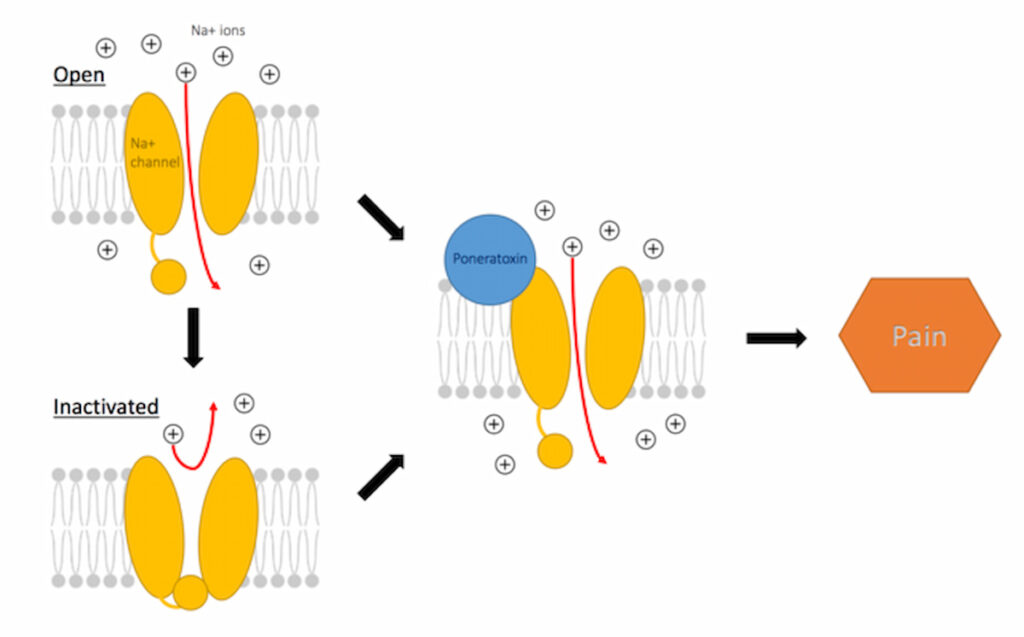
The bullet ant venom causes agony, temporary paralysis, and uncontrollable shaking, among other side effects. Fever, vomiting, nausea, and heart arrhythmia are some more symptoms.
Although rarely, the bullet ant sting can cause allergic responses, increasing the symptoms.
Despite being painful, the bullet ant venom is not fatal to humans, yet it paralyzes and even kills other insects. There’s no doubt the bio-insecticide poneratoxin is a strong contender.
You may also read: Top 7 Ginger Tea Benefits: Boost your immune system
4. Being stung by a bullet ant
It’s crucial to always keep an eye out for bullet ant colonies. Avoiding the bullet ant sting is number one priority!
Wearing over-the-knee boots can be really helpful in these scenarios. Keep an eye on the bullet ant’s first line of defense, as they are a danger zone, in case they feel disturbed.
If you cross the line, bullet ants will bite and latch on with their mandibles before stinging if the threat continues. You can, however, make sure to let them go with a brush or tweezers. If your reaction is quick enough, you may just get away without any sting.
If you were not able to escape, the first thing to do would be to get the ants off the victim. To help reduce the swelling and treat the tissue damage you may use antihistamines, hydrocortisone lotion, and cold compresses.
To treat the pain, prescription painkillers are key. Most bullet ant stings heal on their own if left untreated, however the pain may last for a day and uncontrollable shaking may continue much longer.
5. The bullet ant as a ritual
Brazilian natives from the Amazonian region known as the Mawé still live mostly in seclusion from the outside world. One of their initiation ceremonies has made the tribe quite famous.
As part of the ritual, young men must endure many simultaneous bullet ant stings while remaining calm —as if nothing happened— to prove they have become Mawé warriors.
Boys (some as young as 12) are made to wear a glove with ants anesthetized and sewn inside with their stingers facing inward for 10 minutes.
Source:
Helmenstine, Anne Marie, Ph.D. “The Bullet Ant: The Insect With the World’s Most Painful Sting.” ThoughtCo, Feb. 17, 2021, thoughtco.com/bullet-ant-sting-facts-4174296.
Keep reading: The Mongol Empire: Rise, Expansion, and Legacy