Future of national employment with labor reform and the rise of artificial intelligence (AI)

Ramiro Rueda
Ingeniero eléctrico con MBA y 40 años de experiencia en el sector energético público y privado.
Artificial intelligence (AI), supported by the preceding automation, has burst into all areas of our society and has been revolutionizing different areas of life, including more strongly the workplace, which generates expectations and concerns regarding its impact and the welfare of society in general.
It is imminent, then, to evaluate and explore the relationship between national employment and informality within the context of its growing presence in the market and its potentialization as a consequence of the labor reform proposal of the government of change.
You may read: Second round of labor reform: business associations join in its reformulation
AI, despite being capable of performing tasks such as speech recognition, pattern detection and complex problem solving, still has limitations in terms of its ability to reason and make emotional, creative and ethical decisions. However, the moral degradation of contemporary society’s decision-making is eroding that competitive advantage of the professional force and bringing it ever closer as its replacement.
Within this framework, it is urgent to rethink, in the current global context, the impact on the generation of jobs and the challenges and opportunities that arise with respect to the role played by the government, with its public policy proposals, companies and employees, in the management of human and financial capital and informality; even customers with their decision-making power to demand products and services accordingly.
This reflection seeks to offer an enriching vision on the relationship between unemployment, informality, labor reform and artificial intelligence, providing perspectives that may be useful in understanding these phenomena in the immediate term.
In recent years, AI has facilitated its application in various tasks, by now routine and repetitive, from the automation of processes to the development of machine learning algorithms, and has proven capable of performing actions previously reserved exclusively for humans.
Its ability to execute jobs with greater speed, accuracy, reliability, stability, continuity and lower cost increases work efficiency and improves the productivity of companies, as well as allowing workers to focus on more complex, creative and strategic work.
This creates a challenge and a challenge for human capital in terms of competence and replacement; for government in terms of labor flexibility and decent work; and for organizations in terms of social responsibility and sustainability.
This technological breakthrough, coupled with current proposals for change to tighten labor relations in Colombia, is not without dire consequences for unemployment and informality in our country.
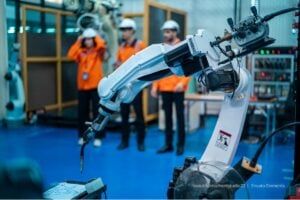
As relations become more rigid and unmanageable, companies adopt smart technologies with a significant decrease in demand for certain trades. For example, automation has led to the accelerated elimination of tasks in sectors such as manufacturing, surveillance and security, transportation, logistics and customer service, and legal and medical services, among many others.
It may also generate inequality in the distribution of employment (and wealth) for those employees who do not have specific skills to work with this technology, who may have greater difficulty finding employment.
In addition, there is the fear (already a reality in developed societies) that, in the near future, Artificial Intelligence may replace functions that are currently performed by highly qualified people, such as doctors, lawyers and bacteriologists, among others.
This should generate, as an integral society, concern and uncertainty about the labor future of millions of Colombians and around the world. It should be a priority to take care of and anticipate decisions with a futuristic vision, not anachronistic, to facilitate the need for ALL actors to adapt to the changes that will occur.
It is also significant to note that AI creates new professions. For example, it requires highly trained professionals who can program, analyze data and improve these systems, automation, robotics, etc., generating new job opportunities in the field of technology and computer science for the development and maintenance of these artificial intelligence systems.
This being so, it is transcendental that governments, companies, collaborators and even customers become aware of the measures and actions, and above all adopt non-anachronistic attitudes to mitigate the negative impacts of this cocktail of technology and public policy.
You may also read: Health reform still does not solve drug prices or system finances, warn UNAL experts
In this way, technology and labor relations regulated with equanimity can be used in a responsible and equitable manner to minimize the possible negative impacts on its population.
Human Capital must face a crucial challenge and its obligation is to adapt to the permanent changes in the market, through constant learning in the acquisition of new digital skills, the improvement of existing ones and the development of those related to technology, mobility and labor flexibility, adaptability, analytical skills and effective communication and collaborative work.
The ability to learn new skills and redefine their role in a changing society is essential to remain relevant in a work environment that is increasingly driven by technology, flexibility and mobility in labor relations.
As certain occupations are replaced by AI and others transformed, employees must ensure their employability by relying on their competitiveness and not on the reinforced stability of the past.
It is essential to acquire and strengthen hard and soft analytical skills that complement the work performed by AI, creative and problem-solving skills that quickly allow them to synchronize with this dynamic and constantly changing work environment.
Government plays a crucial role in managing the unemployment generated by AI and its policies of flexibilization or inflexibilization in labor relations. Its duty is to implement efficient and effective policies based on competitiveness, productivity and rational flexibility, accompanied by the creation of labor reinsertion programs that encourage the training and retraining of workers. In addition, it should promote the creation of jobs in emerging sectors, which is essential to support employees affected by automation.
These measures may include training and economic support to facilitate the transition to new occupations and/or the creation of their own enterprises, supported until their maturity with real policies of promotion by the State. Likewise, work must be done quickly on the ethical regulation of AI.
Companies also have a responsibility in the management of technological unemployment through maintaining as a priority the viability of the organization to grow in jobs accompanied by the implementation of corporate social responsibility practices, such as the construction and development of labor reincorporation plans.
To this end, they can implement retraining programs with reallocation of resources for the acquisition of new skills and promote a culture of support, professional development and promotion of equal employment opportunities aimed at affected workers, including decent and stable remuneration that contributes to a better distribution of wealth.
Even Clients are committed in their decision to support with their demand the products of those companies that have an integral management of human capital with social and environmental responsibility, companies with the SUSTAINABLE seal.
In conclusion, the growing adoption of AI in the labor market and the policies of tightening labor relations have both positive and negative aspects that pose significant challenges in terms of unemployment and informality.
However, it also opens up great opportunities for the development of new skills and the reconfiguration of human labor. The government, companies, workers and even clients must take an active role in managing unemployment, implementing adequate and flexible labor regimes, with reinsertion programs that promote corporate social responsibility and a better distribution of wealth.
With a comprehensive and proactive vision of all actors – Government, Companies, Collaborators and Clients – the challenge of unemployment and informality in the AI era can be positively addressed and its benefits reaped with equity.
These actions can increase efficiency and enhance development in certain sectors, but they can also generate unemployment and labor inequality. Success depends on the even-handed, fair and transparent attitude – evaluating a whole society and not a privileged few – taken by each of those involved in the construction and agreement of the appropriate laws.
This will tip the balance towards the positive or negative consequences. It is in our hands to decide on which side to tilt employment, informality and the future sustainability of Colombians, as a consequence of the application of the IA and the implementation of the concerted labor reform of change.
Time, our children and grandchildren, unemployment and informality will be our implacable judges.
Reindustrialization, a national objective that cannot be postponed, how to achieve it?